the project
A catalogue of sources on an author, in the shape of a tree.
Albera gathers what you need to get to know an author: their books, the people who wrote about them, their own voice, their life, the archives. It judges it source by source and puts it in order. Every source is a leaf; the branches are the categories the sources grow on. At the top the books, underground the roots of their thinking.
how to read it
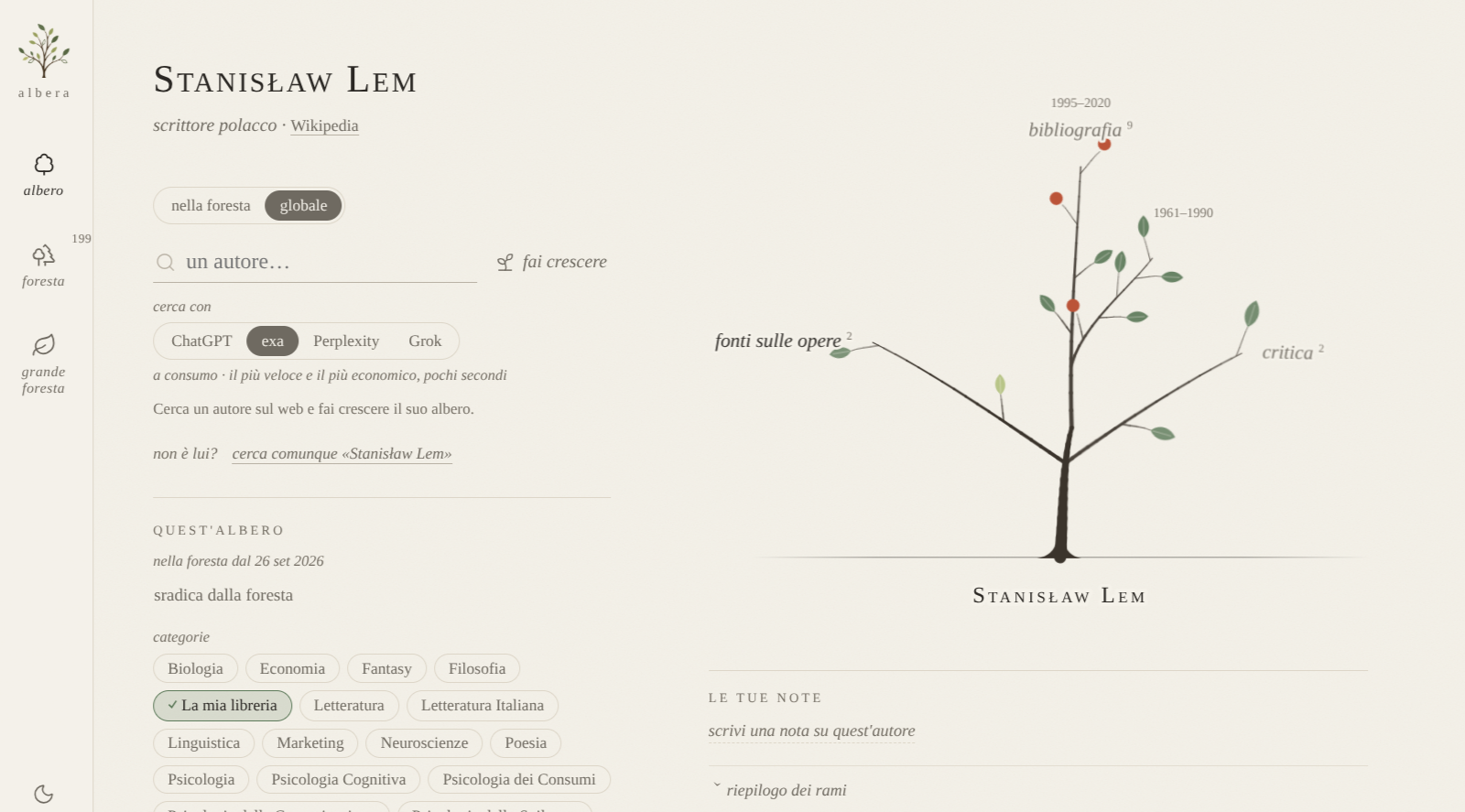
- the top the bibliography from library catalogues, one book per leaf: it carries on from the trunk and splits into periods
- the branches the sources by type: criticism, in their own voice, life, sounds and images, archives, to start with, sources on the works. Dashed if the type is uncertain
- the leaves one source each, the best at the tip: bigger is more worth reading, fuller is more authoritative
- light green: suited to beginners
- the fallen leaves what was discarded, with the reason: dead link, sales page, weak source, off topic, duplicate
- the roots where their thinking comes from: teachers, readings, movements, traditions
- the fruit on the books: full, I own it; outline, to own. Only you see them
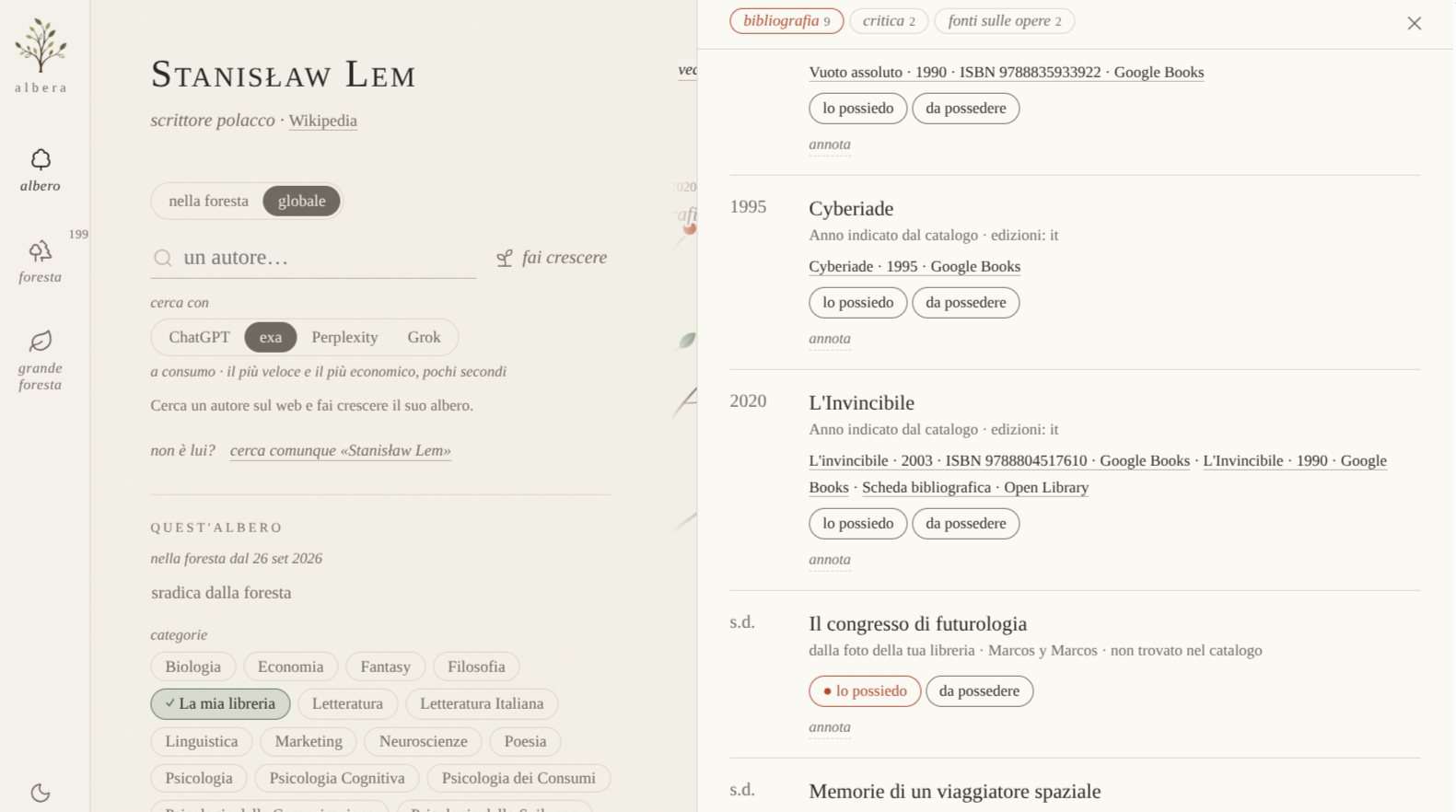
- the side panel opens when you tap a branch: the branches along the top as tabs, the sources best first
you look at the tree, you read the side panel
The drawing is there to see an author all at once, at a glance: where they are rich and where they are thin, how long their bibliography is, how many roots they have. But you don't need to know how to use it. Tap a branch and the side panel opens: the branches sit along the top like the tabs of an index, you move from one to the next and read source by source, best first. Below the tree, the same tree in words: the summary of the branches.
the roots
This is what no other tool gives you: where an author's thinking comes from. Teachers, readings, movements, traditions, each with the link that ties it to the author and the source that says so. And the roots connect: if a teacher already has a tree of their own, you go from a root to them. Under the great forest runs an underground network: who read whom.
who it's for
- for students
- for teachers
- for readers
- for writers
how I use it
To remember which of an author's books I already have, the full fruit, and which I'd like, the outlined fruit. The bibliography comes from library catalogues, and every book has its ISBN with a link to Google Books: when I'm missing a book, I find it straight away.
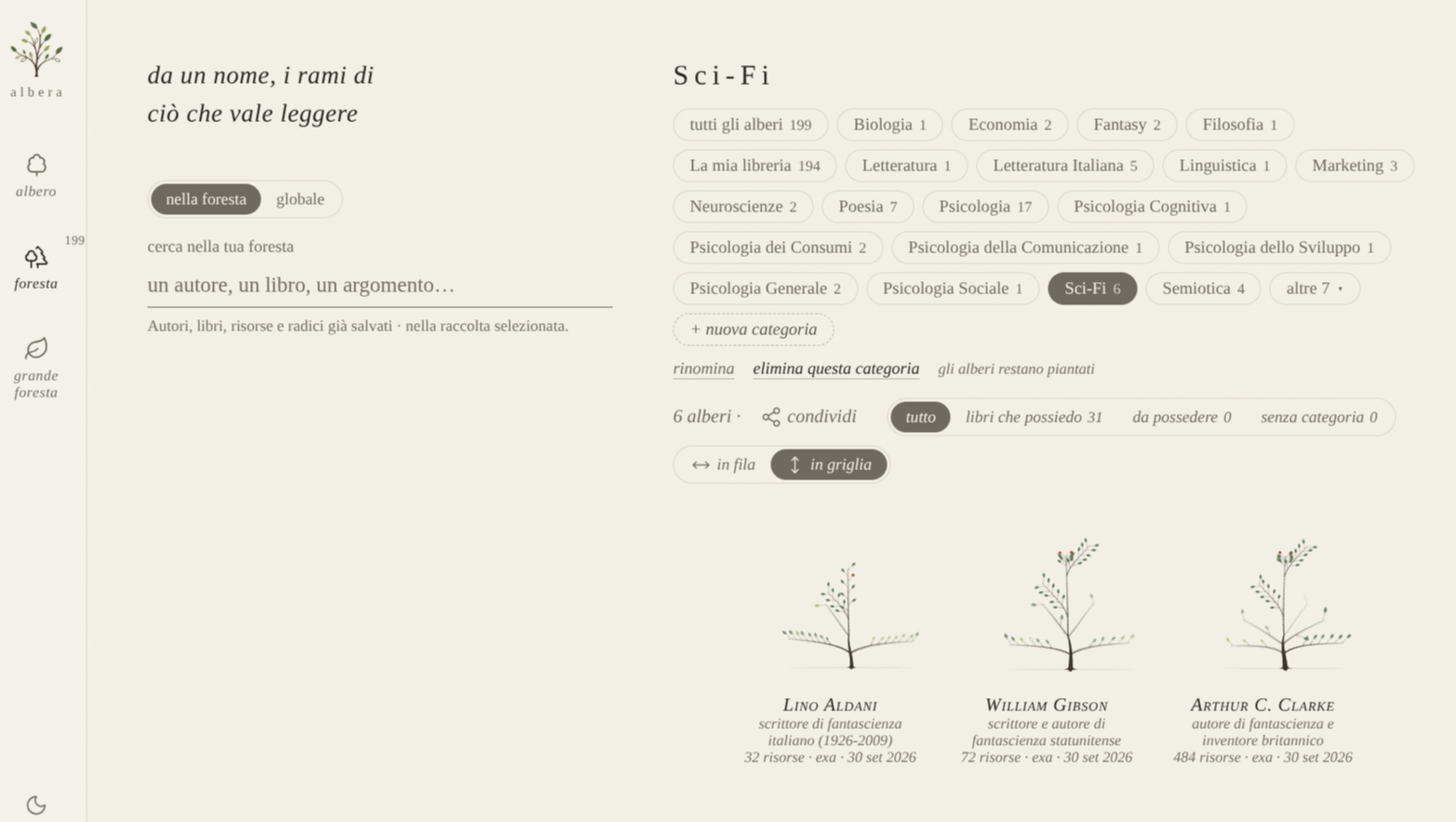
To note down an author I want to explore, with their works, and find them again months later in my forest.
For work: preparing a lesson, gathering the trees for a course in one collection. And an idea I want to try: giving them to students with a link or a QR code, which opens without an account.
- I own it
- to own
the AI layer
In Albera artificial intelligence has two different jobs, and I keep them apart. The AIs that search (Exa, Perplexity, Grok, ChatGPT) find sources on the web and describe them: title, address, an excerpt, the language. They don't judge. Jev judges. And the code decides: anything that can be decided by a rule isn't asked of a model.
- 1the nameWikipedia and Wikidata say who is meant; if the name belongs to more than one person, Albera asks.
- 2the AIs searcheach in its own way, in English, Italian and the author's own language.
- 3the code checksopens every link, removes dead ones, domains for sale and duplicates.
- 4Jev judgesthe same questions for every source, with its certainty for each answer.
- 5the code decidesthresholds the same for everyone: on the branch or on the ground, and in what order.
how Jev works
Jev is a TypeSafe model built to decide, not to write. You don't ask it for an opinion in words: you ask it questions whose answers are fixed in advance (a choice between branches, a yes or a no, a score), and for each one it returns how sure it is. So every judgement can be compared, added up, calibrated. Albera keeps a source on a branch if it is at least 70% relevant and 50% authoritative; it discards it as a sales page if it is one at 60%. The thresholds only move after being checked by hand, on a sample of sources opened one by one.
- branch
- criticism · 100%
- type of source
- academic · 88%
- relevant
- 97%
- authoritative
- 66%
- how deep it goes
- 66%
- for beginners
- 14%
It stays on the criticism branch, among the sources that go deep; not among those for beginners.
why it helps with bibliographic research
A source found by an AI isn't enough: you need to know whether it's good, and why. In Albera every source carries its own judgement, discarded ones stay visible with the reason, and the order can switch from «most worth reading» to «for beginners». The bibliography, on the other hand, is written by no AI: it comes from library catalogues (Open Library, Google Books), matched to the right author through Wikidata, with ISBNs. No invented books. At the top, «where to start»: the author's main works with all their editions; and next to each book the sources on the tree that talk about it, so the book leads to the criticism and the criticism back to the book.
for agents too
A judgement made of answers, not words, is a format an agent can read without having to interpret it. Today agents can read Albera's public pages; opening the trees to the agents of the people who use Albera is the direction.
an economic and social experiment
Albera wants to be a small experiment: a platform where the people who pay enrich information that then belongs to everyone. This is how it works.
- whoever looks up a new authorpays for the search with the credits of their subscription: Exa and Perplexity 1, Grok 3, ChatGPT 8.
- the tree grows for everyoneit joins the great forest, without the name of whoever looked it up.
- whoever comes next pays nothingreopening a tree that has already grown is free, even on the free plan.
- enrich a tree, get some backwhoever grows a sparse branch gets back 5% of the credits spent when others open that tree: the launch-period share, meant to rise with the data.
Information comes from readers too. When a catalogue attributes a book perhaps to the wrong author, the book stays «to be checked» and votes decide: with at least three votes and a margin of two it stays or goes, for everyone. And whoever turns on the humus in their profile lends their votes on sources, without their name, to calibrate everyone's filters.
-
414
trees grown
-
7,197
leaves on the branches
-
143
roots
figures from the great forest, updated 3 October
I don't know yet whether it will pay for itself. That is exactly what I want to find out: whether a collection like this, paid for by the people who use it, grows enough to be worth it for whoever comes next.
why so much care
I believe that soon our personal agents will do our searching for us: fast, precise, and completely invisible to us. Then opening a website or an app will no longer be only about finding a piece of information. It can be an experience: serving a purpose, but also a pleasure, like leafing through an illustrated book or putting a bookshelf in order. Collecting authors, watching your own forest grow, giving a tree to someone. The care isn't decoration: it's the reason to come back.
a one-person company
From that pleasure comes Albera's other question: in the age of AI, can a niche platform made by one or two people sustain itself? Until recently a product like this (search with several AIs, a judgement on every source, catalogues, payments across Europe) took a team and months of work. I built Albera on my own with Claude Code and Codex, two coding agents, in less than a week of work: almost all the code is written together with them, I decide what to do and why.
- the first prototype: from a name, a tree
- online, at albera-books.com
- open to everyone, with subscriptions
- in English too